

Built by the same architectural firm as the State Library of Victoria, Trades Hall has undertaken an eight-year staged program of electrification, energy-efficiency upgrades, and restoration works to dramatically cut carbon emissions, reduce energy bills, and modernise a landmark heritage building without compromising its character or history.
In November 2025 we were nominated for two awards in sustainability and conservation.
These awards recognise the incredible dedication of all those involved in restoring The People’s Palace. They reflect our ongoing commitment to conserving working history while leading the way in demonstrating some of the possibilities available to organisations and the government in a just transition. Unionists have long found collective strength within the walls of Trades Hall.
As Dr Colin Long, Senior Just Transitions Organiser at Trades Hall has said,
“We wanted Trades Hall to practise what we preach on climate and energy efficiency. If we are encouraging organisations and governments to transition, we have to show what’s possible in our own building.”
Working history like nowhere else
Victorian Trades Hall is one of the oldest continuously active trade union buildings in the world – and home to unionist history unlike anywhere else.
Throughout Trades Hall's 170-year history unionists have stood alongside one another and fundamentally transformed Victorian workplaces and culture. Also known as ‘The Parliament of the Workers’, ‘The People’s Parliament’ and ‘The People’s Palace’, Trades Hall was included in the National Heritage List in 2023.
Workers in Victoria were the first to win the right to the eight-hour day without taking a step back on wages and conditions globally.
From the 1882 Tailoresses Strikes leading to better pay for women workers, to the 1907 Harvester Judgement that created minimum wages, this building remembers lifetimes of working history. Parts of it date back to 1859 – while the oldest remaining intact sections have been a hub for Victorian politics and cultural life since 1874.
The murals in Solidarity Hall had been hidden behind metal sheets following a fire in the 1960s, and the tablets in the oldest section of the hall, the Victoria Street Wing, were painted over several decades ago.
Once operating on tallow and whale oil, Trades Hall now takes energy from the sun with the installation of numerous solar panels on the roof, and a new heating and cooling system that is much more energy efficient.
Workers have carefully restored the Victoria Street wing to its former glory and conserved other murals and tablets across the hall. History uncovered reveals that trade unionists substantially funded Melbourne’s early health care system, including funding 50% of the beds at the Austin Hospital.
As The People’s Palace has historically been energy-intensive, reliant on outdated systems, and challenged by the constraints of heritage architecture – upgrades have proven a considerable undertaking.
Melbourne City Council’s 2025 Sustainability Award
We received the City of Melbourne’s 2025 Sustainability Award this November for our work in reducing the carbon footprint at Trades Hall.
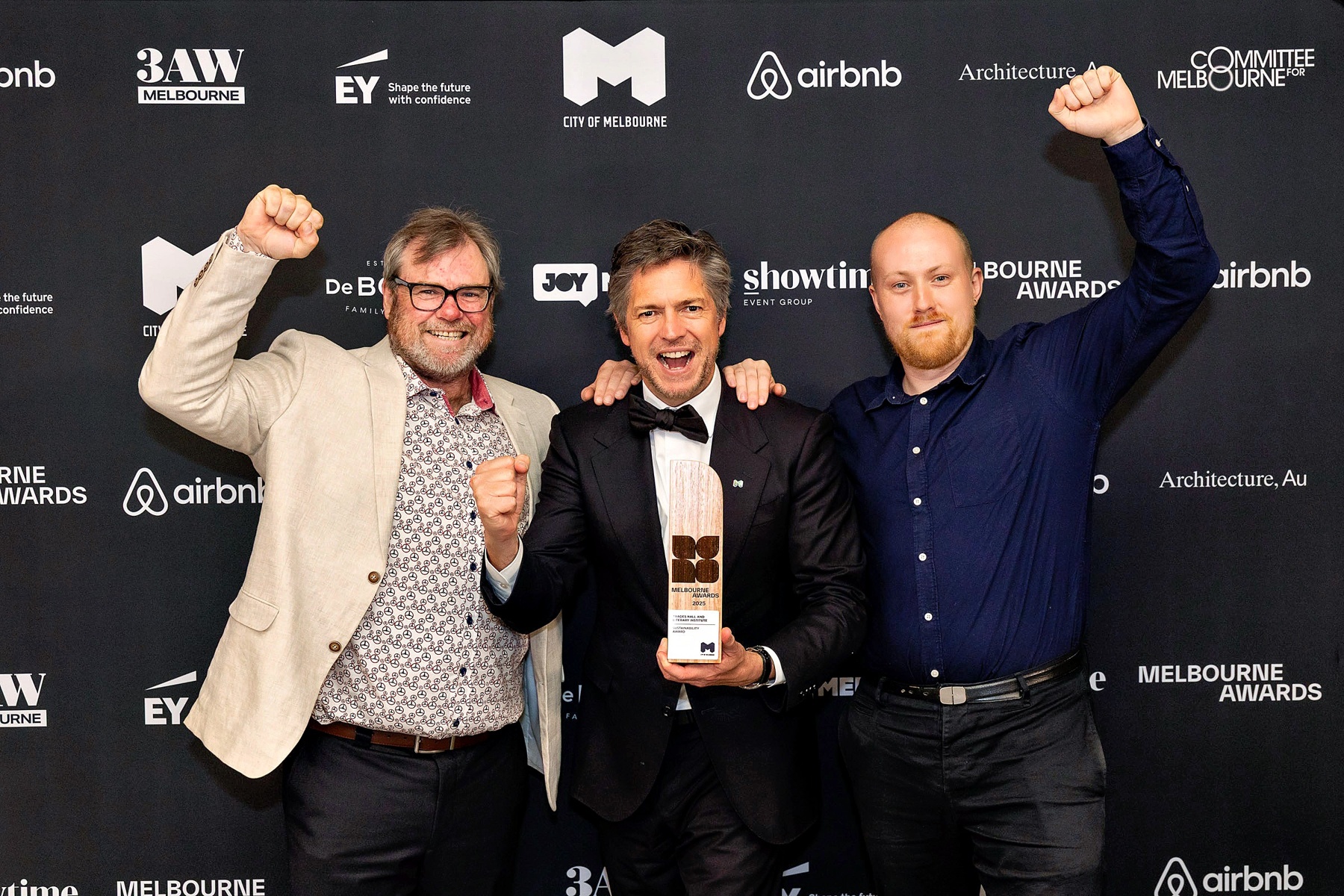
(L+R) VTHC Building and Logistics Organiser Antony Moore, Melbourne City Mayor Nicholas Reece, and VTHC Just Transitions Organiser Charlie Phillips at the Melbourne City Awards in November.
Trades Hall are committed to practising what we advocate for: improving energy efficiency, reducing emissions and demonstrating what heritage owners and community organisations can achieve with a long-term commitment to sustainability.
These principles underpinned every design, engineering and operational decision made across the monumental eight-year program.
Antony Moore, Buildings and Logistics Organiser, says the work required patience and creativity.
“Electrifying a building from the 1800s isn’t straightforward. We were dealing with old timbers, heritage constraints and systems that were never built for modern climate control. Every stage meant working around the historic fabric rather than ripping it out, which meant keeping a lot of embodied carbon in place.”
One of the biggest logistical challenges was removing the gas and modernising used services.
“We removed a 50-year-old boiler, electrified the entire precinct and converted the caretaker’s cottage to fully electric. The building now operates off-grid at times and even exports energy back to the grid.”

Birds eye view of Trades Hall's recently installed solar panels.
Outstanding Conservation Project of the Year
Birds eye view of Trades Hall's recently installed solar panels. The Australian Institute for the Conservation of Cultural Material (AICCM) this month awarded International Conservation Services (ICS) Melbourne Trades Hall Project Outstanding Conservation Project of the Year.
In 2025 International Conservation Services (ICS), led by heritage and architect consultant Lovell Chen, finished the conservation of Trades Hall honour boards and tablets that have been hidden behind layers of paint for at least the last five decades.
Multiplex handled the refurbishment, transforming the well-used but decrepit halls. Uniquely designed carpets that nod to our shared working history, and that are found nowhere else in the world were rolled out across The Parliament of the Worker’s floors.
Eden Christian, Senior Conservator and Team leader for the winning project, received the conservation project award in Brisbane on behalf of ICS for Trades Hall.

Old hand made nails found during renovations at Trades Hall.
What’s next for Trades Hall?
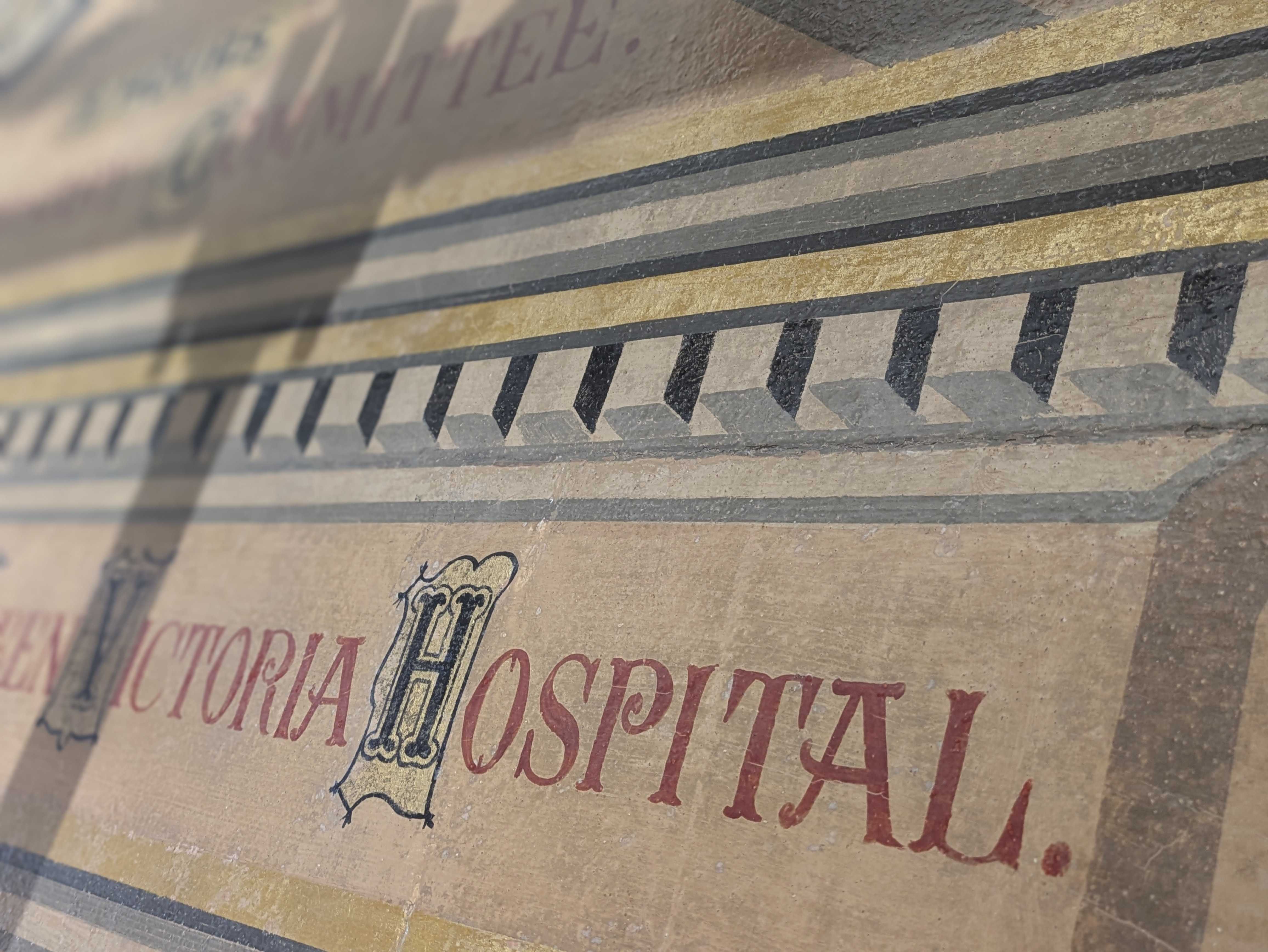
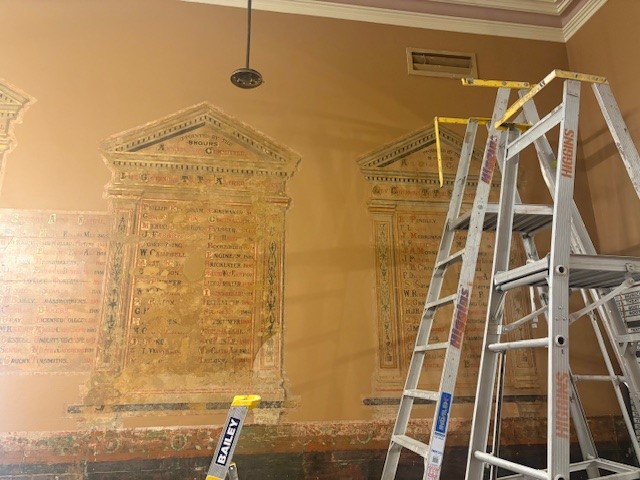
From murals that memorialise the anti-conscription campaigns against Labor in the early twentieth century, to the founding of our healthcare system – the remnants of solidarity remain painted on the walls of Trades Hall.
As we dust the last traces of construction from the specially designed “Bread and Roses” carpet – Trades Hall, its museum and gallery, ETU ballroom, Fringe Common Rooms and many other wonderful spaces are now open to the public to book, visit, and engage with at your leisure.