
Fleeing poverty and indentured servitude in their home countries, the migrants from Europe and Asia who settled in unceded Aboriginal lands in the new colony of Victoria brought with them optimism for a better life. With the astonishing victory of the 8-hour-day in 1856, workers were emboldened to fight for protections and conditions for workers that had never been won anywhere else in the world. This is the story of how workers in union organised and won the human rights every worker in Australia enjoys today.
The Fight for a Decent Living Wage
For generations, working people around the world looked to Victoria for inspiration on how to improve their lives. Victorian workers fought for and won legislative protections that were among the very first of their kind anywhere on earth.
- In 1873, Victoria passed the Factory Act which banned employing young children and established safety inspectors for factories. This was the first ever legislation to protect workers’ rights anywhere in the new world.[1]
- In 1896, Victoria’s Factories and Shops Act set up special wage boards where minimum wages were determined in a range of industries.
- In 1907, the Harvester Judgement was delivered, a legal case involving a Victorian employer which led to the world’s first national minimum wage.
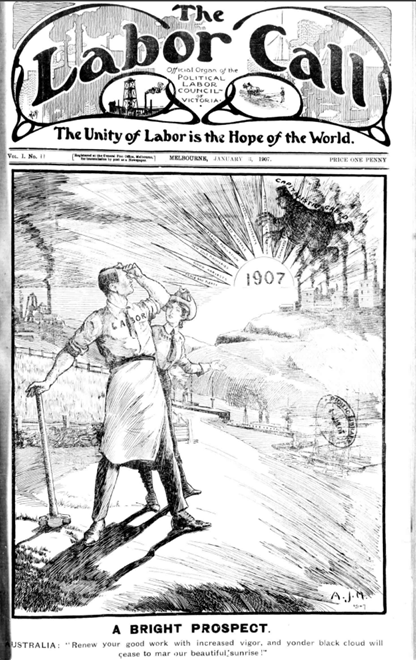
The road to the Harvester Judgement was long. Following the 1873 Factory Act, Victorian workers were inspired to push for further improvements to their quality of life. In the years between 1891 and 1907, membership in Australian unions quadrupled. The number of unions affiliated with the Victorian Trades Hall Council surged. [2]Across the state, workers established their own newspapers and clubs, advocating for a fairer economic system: The Toscin (1897), The Socialist (1906), Labor Call (1906), The Ballarat Evening Echo (1895).
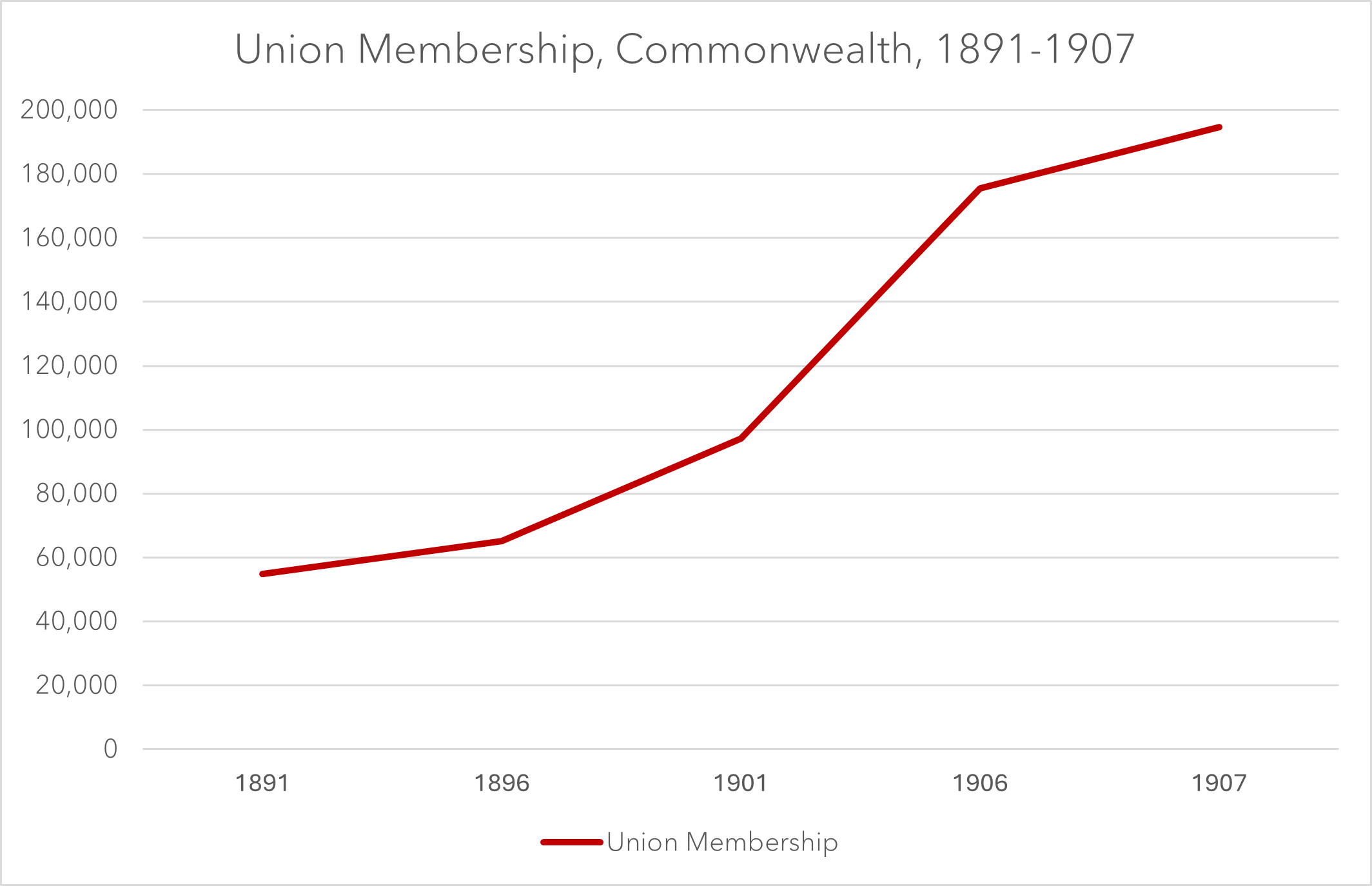
Australian Bureau of Statistics. “Labour and Industrial Branch Report, 1891-1912,” 6101.0, Section II – Labour Organisations, p. 13.Available at: https://www.abs.gov.au/AUSSTATS/[email protected]/DetailsPage/6101.01891-1912?OpenDocument
An Age of Optimism
As Victorian workers became more and more organised and politically engaged, they began to set their sights on broader improvements to their standard of living. A national living wage was seen as one way to achieve this.
In 1906, the Commonwealth Government introduced the Excise Tariff Act. The Act taxed all goods manufactured in Australia – but it included an important exemption. If a factory owner paid ‘fair and reasonable wages’ to their workers, they would be excused from having to pay. However, the Act never defined what counted as ‘fair and reasonable’ and workers soon realized that employers were being given the exemption even when they paid poverty wages.
The Melbourne Trades Hall Council was outraged. The Trades Hall Executive passed a motion was demanding that the Labor Party act to ensure that the Tariff Act would genuinely benefit workers. One unionist, Mr. Smith from the Agricultural Implement Makers Unions, even argued that ‘The Federal Labor members [have] … ought to tackle Sir William Lyne on the matter.’ (Lyne was the Federal Treasurer at the time.) Delegates at the hall responded with cries of ‘hear hear.’ [3]
By 1907, it became clear that the Federal Industrial Court would need to step in. Already, it had received 112 applications from bosses to define clearly what ‘fair and reasonable meant.’ Justice H.B. Higgins chose one in particular to be the defining test case: the Sunshine Harvester Works, one of the largest factories in Victoria operated by a prominent industrialist named Mr H.V. McKay. McKay argued his wages were fair and reasonable, but the workers and eventually the court disagreed.
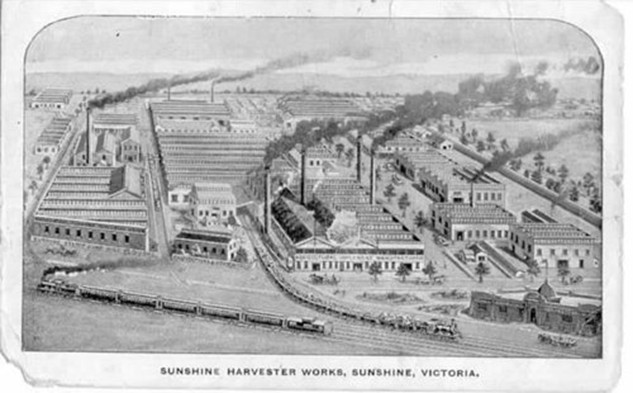
Defining ‘Fair and Reasonable’
Faced with defining ‘fair and reasonable,’ Justice Higgins of the Federal Industrial Court reasoned that fair and reasonable could not simply be the rate of pay achieved by individual bargaining between a worker and a boss – what he called ‘the usual, but unequal … ‘higgling of the market.’[4] If Parliament wanted that, they wouldn’t have included such a clause in the first place.
Instead, Higgins declared that the standard for fair and reasonable has to mean ‘the normal needs of the average employee, regarded as a human being living in a civilised community.’ A wage is only fair and reasonable if it is enough to pay for food and water, rest, clothing, frugal comfort and provision for hard days.
Higgins intended his ruling to guarantee workers a degree of compensation that went further than simply preventing starvation. A fair and reasonable wage means a wage that gives workers the opportunity to participate in society and support a family with several children. He rejected the claim that simple consent from a worker to be paid a certain rate counts as ‘fair.’ In his words, it was not a fair agreement if the worker is motivated by trying to avoid ‘starvation or pauperism for himself and his family.’ No worker would ever agree to this if they were on equal fitting with the boss.[5]
Employers protested Higgins ruling fiercely, deploying many of the same arguments workers hear today about why their wages must be kept low. HV McKay warned that ‘if the men demanded too high wages they would drive work away to the United States.’ [6]
One very important point was made by Higgins in his judgement: no matter the rate of profit, fair and reasonable means fair and reasonable. Regardless of whether the employers’ profits are ‘nil’ or ’100 percent’, fair wages ‘must be paid:’ ‘it stands on the same level as the cost of the raw material of the manufacture.’[7] This reframed decent wages as a standalone right, entirely distinct from how well or poorly the business was performing.
A World Leader
The Harvester judgement became the ‘starting point for all calculations of the basic wage’ in Australia for the following decades.[8] It was quickly established as ‘a landmark of Australian social democracy.’[9] The influence on the Harvester judgement stretched across Australia and far off into other countries too.
Until the 1920s, Victoria’s workplace laws covered more workers than any other minimum wage framework worldwide.[10] This meant that they, along with the Harvester judgement, became a model for industrial regulation around the globe.
United States Supreme Court Justice Louis Brandise drew on the experience of Victoria in advocating for an American minimum wage in 1915.[11] British reformer Sydney Webb did the same.[12] The first British, American and Federal Australian minimum wage laws directly copied aspects of the Victorian legislation. [13]
Fair Wages for Women
The Harvester judgement excluded women from its provisions for a fair living wage. The Commission decided that the women’s rate would stand at 54% of the men’s standard.[14] Women workers and the Melbourne Trades Hall Council protested this. In 1913, a special Women’s Industrial Convention was held at the Hall on the subject of equal pay. It was attended by various MPs, leading women unionists and the Secretary of the Victorian Labor Party at the time.[15]
Miss Lewis, Secretary of the Women’s Branch of the Hotel and Caterers Employees Union and Mrs Barry of the Office Cleaners’ Union passed motions for equal pay and paid maternity leave:
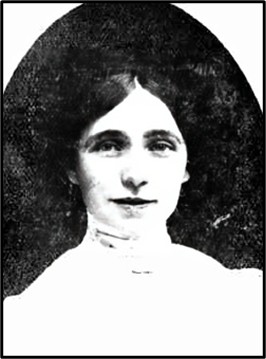
In the opinion of the convention, a bill providing that women shall receive equal rates of pay as much as men … should be introduced in the Federal and State Parliaments, and that the elimination of the word ‘sex’ from the existing factory acts be asked for.[16]
Mr L Cohen, President of the Trades Hall Council at the time, was an emphatic supporter of equal pay for women. When a judge named Justice Cussen argued that women shouldn’t be paid equally because they ‘had no responsibilities,’ Cohen was outraged and successfully moved a motion pushing the movement to take on the fight for wage justice for women.
A mass deputation should approach the Minister, and protest at the action of the judge in knocking out equal rates of pay for equal work… Every delegate on the council was in favor of it, and everyone in the movement should be. They should not let this matter rest, and for a man like Justice Cussen to say that woman had no responsibility, it was diabolical. He should be hounded down, and hounded down he would be.[17]
Miss Mulchahey, President of the women’s section of the Clerks Union was heartened by the support from Melbourne Trades Hall, declaring that male members of the union, in championing for the principle of equal pay for both sexes, have demonstrated that the age of chivalry is not dead.[18]
Conclusion
It took many decades for women workers to be paid a fair wage equal to men. In 1950, the women’s wage was raised from 54% of the male rate to 75%. In 1969 and 1972, equal pay for equal work decisions lowered the gap further, to between 71% and 93%. However, even now, over a hundred years since the 1907 Harvester judgement, the gender pay gap persists: standing at 21.8% in the private sector.[19]
Migrant workers, workers on junior wages and workers with disabilities also represent unfinished frontiers in the fight for fair wages. All three of these groups are subject to various degrees of both legal and non-legal discrimination from employers that see them miss out on opportunities for decent, fair compensation. Young workers, for example, can be paid well below minimum wage despite having to pay the same costs, taxes and bills as everyone else.
The work of the union movement in securing equal pay for all is incomplete. So too is the fight for a universal living wage. In the years since 1907, anti-union legislation, deregulation and aggressive wage suppression from employers have undermined the core principles of the Harvester judgement: that a decent life should be guaranteed to all who work. Then, as now, workers will have to come together and mobilise using the best tools at their disposal: solidarity, courage and collective action.
[1] Andrew J Seltzer. 2024. “The Political Economy of Minimum Wage Setting: The Factories and Shops Act of Victoria (Australia) 1896-1913.” Institute of Labor Economics, p.2, p. 23.
[2] Macarthy, P. G. “Victorian Trade Union Statistics, 1889-1914.” Labour History, no. 18 (1970): 68–74. https://doi.org/10.2307/27507974.
[3] The Age, “Case Discussed at Trades Hall,” 5 Oct 1907, p. 13
[4] Ex Parte HV McKay (Harvester Case), Judgement. Commonwealth Court of Conciliation and Arbitration. (1907) 2 CAR 1, Higgins J, President, 8 November 1907.
[5] Ex Parte HV McKay (Harvester Case), Judgement. Commonwealth Court of Conciliation and Arbitration. (1907) 2 CAR 1, Higgins J, President, 8 November 1907.
[6] The Age, “Case Discussed at Trades Hall,” 5 Oct 1907, p. 13
[7] Ex Parte HV McKay (Harvester Case), Judgement. Commonwealth Court of Conciliation and Arbitration. (1907) 2 CAR 1, Higgins J, President, 8 November 1907.
[8] P.G. Macarthy. 1968. “Victorian Wages Boards: Their origins and the doctrine of the living wage,” Journal of Industrial Relations, Volume 10, No. 2, pp. 116-34; Dick Bryan. 2008. “Minimum Living Standards and the Working-Class Surplus: Higgins, Henderson and Housing.” Labour History, No. 95 (November 2008), pp. 213-221.
[9] Stuart Macintyre. 2004. ‘Arbitration in Action,’ in Stuart Macintyre and Joe Isaac (Eds), A New Province for Law and Order: 100 Years of Australian Industrial Conciliation and Arbitration, Cambridge University Press, Melbourne, 2004, p. 63.
[10] Andrew J Seltzer. 2024. “The Political Economy of Minimum Wage Setting: The Factories and Shops Act of Victoria (Australia) 1896-1913.” Institute of Labor Economics, p. 23.
[11] Louis D. Brandeis. 1915. “The Constitution and the minimum wage: defence of the Oregon minimum wage law before the United States Supreme Court.” The Survey, pp. 490-94 and pp. 521-524.
[12] Sydney Webb. 1912. “The economic theory of a legal minimum wage.” Journal of Political Economy, Volume 20, No. 10, pp. 973-98.
[13] Andrew J Seltzer. 2024. “The Political Economy of Minimum Wage Setting: The Factories and Shops Act of Victoria (Australia) 1896-1913.” Institute of Labor Economics, p. 23.
[14] Andrew J Seltzer. 2024. “The Political Economy of Minimum Wage Setting: The Factories and Shops Act of Victoria (Australia) 1896-1913.” Institute of Labor Economics, p. 24.
[15] The Age, “Work and Wages: Women’s Convention – Equal Pay for Equal Work.” 27 September 1913, p. 19.
[16] The Age, “Work and Wages: Women’s Convention – Equal Pay for Equal Work.” 27 September 1913, p. 19.
[17] Labor Call, “Trades Hall Council,” 20 March 1913, p. 4.
[18] The Argus, “Tuesday – October 22 1912” 22 October 1912, p. 6.
[19] https://www.wgea.gov.au/pay-and-gender/gender-pay-gap-data